In this blog you will find different resources provided by a future teacher who will be very useful for use in the primary classroom. These resources are divided into two big groups: classroom language and literacy.
With these activities and materials we’ll make a meaningful and funny learning of English.
To work daily routines in class, especially with very young learners, it's important to be able to integrate and remember them. For this, we use songs or flashcards with the actions to do it more fun and visual, and our students will remember and perform it correctly.
For example, I'll show you a funny song with a nice rythm for tidy the class, as well as some of the flashcards we make of it.
Main priorities when teaching your pupils to read in English:
- Focus on meaning
- Word recognition
- Making the connection between familiar sounds and written words or phrases
- Naming the letters of the alphabet
- Predicting the pronunciation of a written word
Teachers often use it as part of vocabulary teaching. When children learn to say a new word they learn to read it. You can help children with whole word recognition by using printed material as much as you can in your classroom. This can also be done with phrases.
Also, children need to learn how to recognize sounds and letters.
Young learners:
- Can learn obvious letter patterns that help with sound recognition and help them predict words, for example, shop, jam, etc. Visual clues make words and phrases easier.
- Will not need to know the formal names of the letters until they start to write and spell. Another way to help children with sounds is to let them play with the sounds as they repeat a word they are reading on a card or in their book.
Activities to help children connect sounds with letters
1. Memory games.
Match the letter with the correct picture. Remember the places!
2. Initial letter games.
Write the first letter of these pictures.
3. Feel the letter.
Close your eyes and find the letter “C” of cat.
4. Make an alphabet frieze with card spaces underneath for lots of extra words those children can recognize and read.
Activities to help children connect sound recognition with clusters of written letters.
- Make children aware of the patterns in - Final word endings that rhyme in songs and chants
- Games and songs with a focus on beginning sounds - Displays or games that emphasize a particular sound.
- Help them focus on visual sound patterns, for example, pl cluster in plant, planet, plane, and the st cluster in star, stamp, story. - Talk about these patterns with the children - help them to see how they can use this awareness to guess words.
- Let children point to these patterns/words when you are all reading something together.
- Colour or highlight these patterns on word cards.
It’s important to help our pupils remember and pronounce new vocabulary. Using 'word reading' as part of vocabulary learning, children learn about rhythm and intonation as they learn new words and how to associate meaning and sound with the written word when they read.
Summary of the class activities:
- First sticks up pictures of the six words on the board.
- Then uses a tambourine to beat out the rhythm of the new word.
- Finally says a chant with the children using the new words they are learning.
In this activity each child is a character of a story. First, the teacher will read the story, while the children listen attentively. Then, the roles are distributed and each child will make a different character.
In this way they will develop social skills and teamwork, and also the strengthening to understanding of history.
Another way to get kids involved in the story and enjoy it is interacting with them while the story is told. So, if the teacher says: the snakes are moving across the floor, children crawl by the floor imitating them. With moves, jumps, gestures, etc., children will feel into the story.
Greetings and goodbyes
Say good morning, good afternoon, hello and goodbye.
How are you? Fine, thank you.
To work with the different forms of greeting, as well as to ask "how are you?" and know how to answer correctly, it's very useful to employ songs. If they are attractive and catchy, the kids will learn more easily.
Muffin Songs - Hello (nursery rhyme)
Good Morning Song | Circle Time Song for Children
The Greetings Song
Feelings
Express feelings: happy, sad, cross, angry, hungry, frightened, scared, surprised and shy.
In this game we will learn to differentiate and express emotions. First, the teacher shows to only one child a flashcard with an emotion, for example happy. This child has to represent that same emotion with his face or gestures, and show it to a partner. All other children will be in a line, and they will pass the emotion to the mate of the back. The last student in the line will have to identify the emotion that his partner has provided with other flashcard located in the table.
The first flashcard should match with the last.
Personal hygiene and health
Understand that sweets cause tooth decay.
Healthy eating and brushing your teeth is very important for health!
First, we show a simple song that explains the importance of brushing your teeth every day. Later, we'll do an activity in which we qualify, in one hand the healthy food and in the other, those that cause tooth decay.
Song: Brush your teeth
Activity:
Behaviour patterns
Promote positive behaviour patterns in the school, in the classroom and in the playground.
For a good behaviour we will use some simple and clear rules. They shall be attached by drawings that represent it and will be located at a specific site, for example, the rule: throw papers in the bin, will be placed on the wall above the bin. So children can learn and remember it more easily.
Sharing and participating
To work with children the values of sharing and taking turns we will use the book: "share and take turns".
The literature, especially in very young learners, it's very useful and effective in learning.
Showing respect
For people:
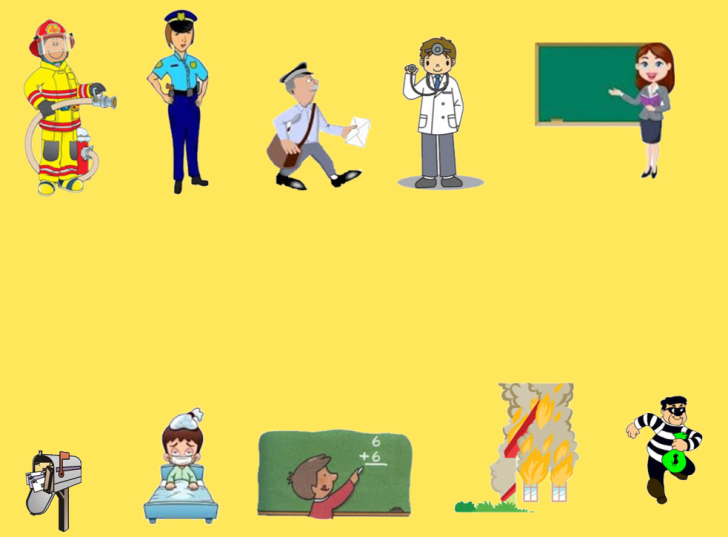
Have an appreciation of people who help us in our daily lives.
With this activity we will teach the different people that live in our community and provide different services.
The goal is to match each person with their job. In this way, children can understand how others help us.
For things:
Take care of classroom equipment.
The activity consists of a PowerPoint presentation in which Mr. Wiggles is giving different advices about the use of books to teach children to take care materials.
Show curiosity about the immediate environment.
To make children aware of environmental pollution, we will use a video of a few minutes in which, in addition to explaining how pollution affects to the world, gives some advices to prevent these problems.
This animation is very visual and entertaining so kids will learn while having fun.
It's important to make activities with movements to encourage children to learn.
One example could be telling a little story, making a sequence with movements and different expressions. Children listen and repeat the sentences, doing the correct movements in each moment.
Important:
- Repeat the sentences - Maintain the order
Memory improves with movement and later they'll be able to perform the movements in a different order.
Here I'll show you some suggestions for starting your lessons in English:
• Some suitable phrases for greetings and forms of address:
TEACHER
CHILDREN
Good morning, children
Good afternoon, everybody
Hello, boys and
girls/girls and boys
Good morning, Miss/Mrs/Mr/Ms
Good afternoon, [surname]
Hello, [first name]
Teacher
Let’s
call the roll
Let’s
take the register
Let’s
check to see who is here
Remember
to answer ‘I’m here’
Thank
you, everybody.
So,
everyone is here except…
So,
only two people away
Is
everybody here?
Is anyone away?
No-one absent today? Who is missing?
Let’s all count to
see if everyone is here – girls first, then boys
Oh
good, Paula, you’re back. Nice to see you. Are you right now?
Oh,
John’s away. Who knows why? Is he ill?
So, how
many is 13 and 15? Ok… yes? So that is 28 altogether
Maybe
he’s gone to the dentist. What do you think?
Is that
more than yesterday? Or less than yesterday? Or the same?
Ways of starting lessons:
Check attendance
Rearrange the classroom
Sing a song
Say a rhyme
Do question routines
Play a game
Take the register/call the roll
• Some tips to organise your classroom:
1. Get your books and pencils out
2. Pick your pencils up
3. Move the tables back
4. Turn your chairs round to face the wall chart
5. Put all your things away
6. Close the window beside you
7. Put your pencils down
8. Turn back to face the front
9. Leave these tables here
10. Leave the window open
• For ending your lesson, real examples:
- Ok, that’s all for now.
- Right. We’ve no time for anything else – don’t do any more – we don’t have any more time today.
- Ok – just one more time before going out for a short break.
- Ok, now stop! We haven’t enough time to finish the monster today. So stand up…
- Ok – just one more time – and then that’s it.
- Ok, pick up all your things – and put the books in the cupboard.
- That’s all for today. On Monday, there’ll be more.
- Ok, children, make a line to say good bye – following the leader. Bye bye.
- Ok, it’s break-time. So you can go out to play. But first – line up quietly by the door
This book is a essential guide for teachers of general English, young learners and CLIL. Includes units of essential theory, practical teaching advice and classroom ideas.
Here I will show some PowerPoint presentations as a summary of three of the main themes inside the book.