
In this blog you will find different resources provided by a future teacher who will be very useful for use in the primary classroom. These resources are divided into two big groups: classroom language and literacy. With these activities and materials we’ll make a meaningful and funny learning of English.
Mostrando entradas con la etiqueta Literacy. Mostrar todas las entradas
Mostrando entradas con la etiqueta Literacy. Mostrar todas las entradas

Different genres
Here I'll show you different charts in which are classified the different genres or text types.

- Expository

- Narrative

- Persuasive

- Procedural

- Transactional

Different types of texts for effective reading instruction
This table, designed by J. David Cooper shows the different types of texts for Reading instructions. I think it's useful to read.

YEAR 6: Kensuke's kingdom
To work with this book, Kensuke's kingdom, for year 6, we will make a fun activity that will can serve as a "summary" of the story ", touring the different places where the protagonist travels.
For this, we work with an online tool called TripLine.
Tripline is an application that helps you to create animated maps and telling stories through an interactive map that moves through the various points through which we passed. You can add images, music and a brief explanation.
Here you can see an example of the map I made.


For this, we work with an online tool called TripLine.
Tripline is an application that helps you to create animated maps and telling stories through an interactive map that moves through the various points through which we passed. You can add images, music and a brief explanation.
Here you can see an example of the map I made.
The true story of the three little pigs
Also, we can work this story with different worksheet to know the point of view of the characters.


YEAR 5: The true story of the three little pigs
This book tells the story of the three little pigs but very changed. From this point of view and knowing the traditional story, a highly recommended activity for our students is to create a Venn diagram with two stories.
This type of visual organiser shows the similarities and differences in the intersections of two circles. Similarities are in the intersection between the circles and differences are in the parts of the circles which do not intersect.
Here I show you two types of Ven diagrams about these two stories.

This type of visual organiser shows the similarities and differences in the intersections of two circles. Similarities are in the intersection between the circles and differences are in the parts of the circles which do not intersect.
Here I show you two types of Ven diagrams about these two stories.
YEAR 4: The owl who was afraid of the night
To work with this book, for year 4, we will use an online resource called nearpod.

It is a useful and practical educational tool with which you can create lessons via iPad and computer and share them on the same platform for students to follow the lesson and interact with performing exercises on the same tablet.
The application also lets you create quizzes, presentations, surveys ... all this material can be shared directly with students.
Once finished the exercises, teachers can see the questions for each student individually or as a class list.
A disadvantage is that every child has an iPad or PC to perform the exercises.
Our nearpod about "the owl who was afraid of the dark" is the next:

YEAR 3: Lazy jack
LAZY JACK
This book, for year 3, offers the possibility to work in depth with the characters. Therefore, adjectives will be one of the main activities.With "Kidspiration" you can arrange your characters' adjectives and make a diagram to see them easier.
Here I leave a link to the diagram I made.
https://www.dropbox.com/s/chd2o0ive3qm9ob/JACK.kid?dl=0
Also, we can continue making simple sentences with the selected adjectives.

Once we understand the story, we are able to make a little analysis of the history. To make it more visual, with black cardboard, we'll make the shape of a hat. We could add a red ribbon and also write with chalk, giving a fun touch.

This strategy combines movements and learning.
Performance of the water cycle
Another good idea to finish the job with the book "the drop goes plop" is to perform a play about the water cycle.
In groups, each child will be a character (drop, cloud, reservoir ...). It can be performed in different ways, but one of the most simples is to make it through masks or drawings.
I think it's a form of learning in which, although children may come to memorize phrases, they're learning in a fun way. Even so, not everything is memorize because through the drawings, children will relate the different stages of the cycle.
We can also let children express themselves freely, as happens in the story, but in their own words. So we'll make sure they have understood.
When the performance has finished, we can put the masks on the wall of our class to decorate.

In groups, each child will be a character (drop, cloud, reservoir ...). It can be performed in different ways, but one of the most simples is to make it through masks or drawings.
I think it's a form of learning in which, although children may come to memorize phrases, they're learning in a fun way. Even so, not everything is memorize because through the drawings, children will relate the different stages of the cycle.
We can also let children express themselves freely, as happens in the story, but in their own words. So we'll make sure they have understood.
When the performance has finished, we can put the masks on the wall of our class to decorate.
O-W-L chart
An O-W-L (Observations, Wonderings, Learnings) chart can help students organize their thinking around a concept. Before reading a book, helps them better engage with the text and, therefore, makes the text more meaningful.
The next pictures show an example of a O-L-W chart designed with the "drop goes plop" book.


The next pictures show an example of a O-L-W chart designed with the "drop goes plop" book.


Useful connectives
Here I share a table with some connective words that I think will be very useful.

YEAR 2 NON-FICTION
THE DROP GOES PLOP


Books of butterflies (fiction and non-fiction)
From the book "the very hungry caterpillar" I decided to create a list of some books about butterflies, both fiction and non-fiction, for different ages that I think suitables to work in the classroom and I recommend.
I hope you like it.


I hope you like it.
The very hungry caterpillar word level
There are much activities to do with this book. Some of them are:
ACTIVITY 1. What does the Very Hungry Caterpillar eat today?
We have the days of the week and then the names of fruit in our Word Wall. Children have to listen carefully to the teacher when she reads the story, and then, they have to match the cards with the name of the days with the fruit that the caterpillar eats each day.
The goal of the activity is that the children should be able to recognize the written words of days of the week and fruits.
If we would like to extend this activity, we could add cards with the name of the numbers to the Word Wall and ask the children to find the num ber of fruits that the caterpillar eats each day.

ACTIVITY 2. Point the words
In this activity, we work with high frecuency words related with the story “The very hungry caterpillar”. We use a Word Wall, and the children have to point specific words, acording to the following intructions:
- Can you point a word that ends with the letter “e?”
- Can you point a word that starts with the letter “c”?
- Can you point a word that has two syllables?
- Can you point a word that means “very small”?
- Can you point a word that makes sense in this sentence: “he was ___ very hungry”?
- Can you point a compound word?
- Can you point a word that rhymes with “moon”?

ACTIVITY 3. Do you remember how the story develops?
We can use questions like:
- When appear the word ‘egg’?...
- Can you find the word “ice-cream”? Can you stand up and point it?...
- How was the caterpillar at the beginning? Tiny, isn’t it? And when it ate so much food, how was it?So we put “big” in the beginning or the middle?
- Can you drag the word for me?...

ACTIVITY 4. I spy…
In the smart board, we show the children different pictures about the story and a determinate lines’ number. Each line is related with each letter of one of the picture´s word. The children have to guess the word seeing the picture and collocate and write it in the spaces. Can be more than one possibility for each picture.
For working with this activity we use the idea of “I spy with my little eye something that…”
· Clue 1. It´s in the picture.
· Clue 2. Ends with the letter …
· Clue 3. Has the letter … in it.
· Clue 4. Has … letters.
· Clue 5. Fits in the sentence:

ACTIVITY 1. What does the Very Hungry Caterpillar eat today?
We have the days of the week and then the names of fruit in our Word Wall. Children have to listen carefully to the teacher when she reads the story, and then, they have to match the cards with the name of the days with the fruit that the caterpillar eats each day.
The goal of the activity is that the children should be able to recognize the written words of days of the week and fruits.
If we would like to extend this activity, we could add cards with the name of the numbers to the Word Wall and ask the children to find the num ber of fruits that the caterpillar eats each day.
In this activity, we work with high frecuency words related with the story “The very hungry caterpillar”. We use a Word Wall, and the children have to point specific words, acording to the following intructions:
- Can you point a word that ends with the letter “e?”
- Can you point a word that starts with the letter “c”?
- Can you point a word that has two syllables?
- Can you point a word that means “very small”?
- Can you point a word that makes sense in this sentence: “he was ___ very hungry”?
- Can you point a compound word?
- Can you point a word that rhymes with “moon”?
For this activity we need our story Word Wall with a table divided in beginning, middle and end, and also promptcards of content words that appear in the story. Children have to listen carefully to the teacher when she read a word. Then, the whole class will discuss where we should put this word. Finally the teacher will put the word in the correct box.
The goal of the activity is that the children should be able to recognize the content words of the story and also be able to order the story.
We can use questions like:
- When appear the word ‘egg’?...
- Can you find the word “ice-cream”? Can you stand up and point it?...
- How was the caterpillar at the beginning? Tiny, isn’t it? And when it ate so much food, how was it?So we put “big” in the beginning or the middle?
- Can you drag the word for me?...
ACTIVITY 4. I spy…
In the smart board, we show the children different pictures about the story and a determinate lines’ number. Each line is related with each letter of one of the picture´s word. The children have to guess the word seeing the picture and collocate and write it in the spaces. Can be more than one possibility for each picture.
For working with this activity we use the idea of “I spy with my little eye something that…”
· Clue 1. It´s in the picture.
· Clue 2. Ends with the letter …
· Clue 3. Has the letter … in it.
· Clue 4. Has … letters.
· Clue 5. Fits in the sentence:
Word families
Besides make a word bank with drawings and words of the most important things in the story, from it, we can work the matter of word families.
We found different families of words in this story, but we will focus especially on the food (although all families may work in depth, this is more representative).


We found different families of words in this story, but we will focus especially on the food (although all families may work in depth, this is more representative).
Butterfly life cycle
Another theme that we can work with the book, which is very evident, is the life cycle of the butterfly.
By reading the story, we'll note down the development and the different states that it have to pass to become butterfly.


By reading the story, we'll note down the development and the different states that it have to pass to become butterfly.
YEAR 2 FICTION
THE VERY HUNGRY CATERPILLAR
When we've read this book, it's a great idea to create a VCOP.
Each letter of VCOP stands for an aspect of writing that will help them improve all writing in every subject.
V = Vocabulary (the words they use in their writing)
C = Connectives (we call them joining words)
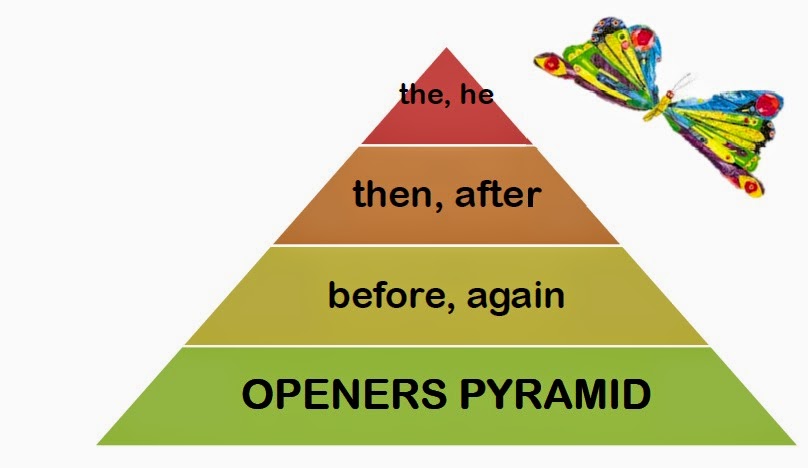
O = Openers (we use these words to open or begin our sentences)
P = Punctuation (the marks we use to help our writing make sense)



Suscribirse a:
Entradas (Atom)